
• Maritime Finance Software
The fine isn't for
getting the rate wrong.
It's for
not being able to prove
you got it right.
Your reconciliation uses the time you planned to cross the boundary.
TaxNav uses the time you actually did.

THE PROBLEM
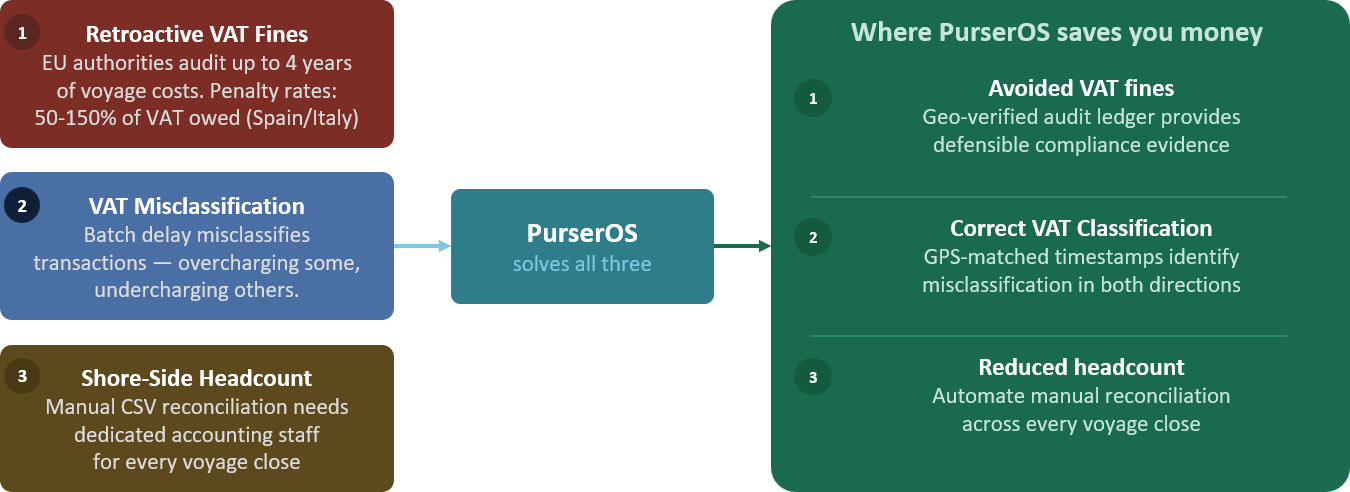
Two major pain points.
Still unsolved.
Modern cruise ships are extraordinarily complex financial entities, yet the software managing their accounting is largely unchanged from the early 2000s.
-
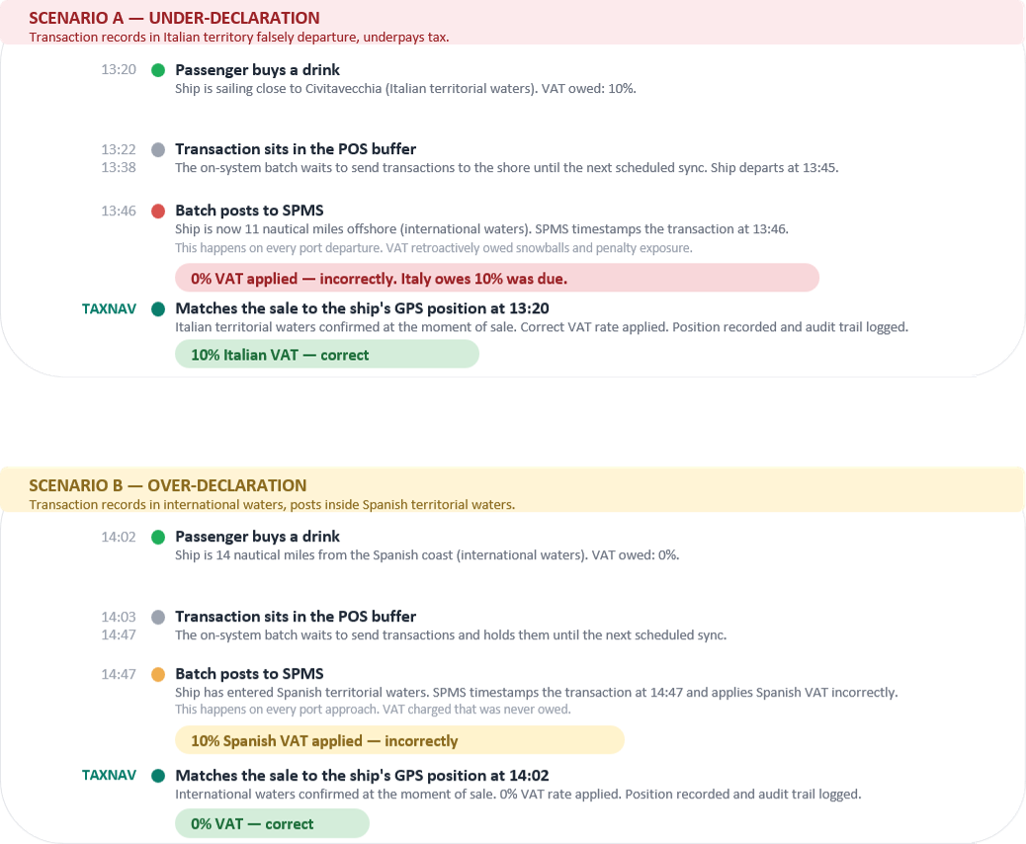
The batch delay is not a software quirk. It is a compliance liability.
At 16 knots, a cruise ship covers 8–35 kilometres during a typical Fidelio batch lag. On any port departure or arrival, that window can span a jurisdictional boundary — meaning the wrong VAT rate was applied, regardless of your policy.
The error runs in both directions. Transactions occurring in international waters post inside Spanish territorial waters: VAT charged that wasn't owed. Transactions occurring alongside in an Italian port post after departure: VAT not charged that Italy says was due. Both happen on the same voyage.
Your finance team corrects this manually every month, working from scheduled itineraries and posted timestamps. TaxNav replaces that process with GPS-matched classification on every transaction, at source.
-
Your duty-free strategy is sound. Proving it is harder than it was.
If your itinerary includes a non-EU port call — Gibraltar, Tangier, Montenegro, or a UK homeport — your duty-free exemption is legitimate and your team knows how to apply it. That is not the issue.
The issue is that Italy and France have introduced use-and-enjoyment mandates that move the burden of proof from itinerary level to transaction level. It is no longer sufficient to demonstrate that your voyage called at a non-EU port. Tax authorities now require GPS-timestamped evidence that each duty-free transaction genuinely occurred outside EU territorial waters — at the moment it occurred, not the moment Fidelio recorded it.
A scheduled itinerary cannot provide that. A posted timestamp cannot provide that. Only a GPS-matched transaction record can.
Without it, your exemption is an assertion that invites challenge. With it, it is a proof that ends one. TaxNav produces that record automatically on every transaction, for every voyage.
In practice, these challenges often combine into a significant financial exposure: retroactive VAT fines covering a multi-year audit window, VAT over-charged on international water transactions and paid unnecessarily to governments, and the ongoing cost of shore-side staff manually reconciling what PurserOS automates.

THE SOLUTION
One focused solution.
TaxNav is purpose-built to solve the VAT timestamp attribution problem that every EU cruise operator is currently managing manually.

✓
Matches each transaction timestamp to
the ship's GPS position in real time
✓
Classifies position as international waters,
territorial waters, or named port jurisdiction
✓
Applies correct VAT rate and tax code
from a maintained rules database
✓
Outputs ERP-ready journal file
(SAP IDOC, JDE batch, NetSuite CSV)

HOW IT WORKS
Middleware that fits
between your existing systems.
PurserOS requires no changes to your SPMS or ERP configuration.
It connects in days, not months.

SPMS Transaction Ingestion
Transaction logs are pulled from Oracle Fidelio SPMS via REST API or scheduled CSV export. Each record includes the hardware terminal timestamp (POS_DEVICE_TIMESTAMP) — not the delayed batch sync time.

Bridge GPS Feed Ingestion
Separately, the ship's bridge navigation system streams real-time position data in NMEA format. This is an independent system — GPS does not come from Fidelio. PurserOS ingests both feeds simultaneously.

Jurisdiction Classification
Each transaction's device timestamp is matched to the ship's GPS position at that exact moment. The rules engine determines whether the sale occurred in international waters, territorial waters, or a named port jurisdiction.

Tax Code Application
The correct VAT rate and ledger code is applied for each jurisdiction. Any edge cases are flagged automatically for human review before the output is generated.

ERP-Ready Output
A journal file is generated in your ERP's native format (SAP IDOC, JDE batch, NetSuite CSV), ready to post without manual intervention. A voyage-level exception report is produced alongside it, showing every transaction where the GPS-matched jurisdiction differed from the SPMS batch timestamp.
The problem has already reached regulators and courts.
These are not hypothetical risks. They are documented outcomes from operators who faced exactly the compliance gap TaxNav addresses.
📋 EU Use and Enjoyment Mandates
Italy and France have both eliminated flat-rate itinerary estimates for maritime VAT. Italy revised its calculation method for time spent in non-EU waters effective April 2020; France applies a comparable pro-rata system. In both countries, operators must provide documented, verifiable proof of time in international waters to qualify for a reduced effective VAT rate. Manual reconciliation — without digitally logged position data — is no longer sufficient to satisfy tax authority requirements.
⚠ 2023: Major Operator POS Config Failure
A leading global cruise line was forced to notify guests that VAT had been incorrectly applied to beverage and dining package purchases — in some cases charging Spanish or French VAT on consumption that occurred outside those territorial waters. The operator subsequently issued partial refunds and reversed charges on affected sailings. The episode demonstrated that even at the scale of one of the world's largest fleets, geo-accurate VAT classification cannot be managed through standard POS configuration alone.
⚖Oslo District Court — Intl. Cruise VAT Ruling
(Oslo District Court — TOSL-2024-156985) In a ruling upheld by the Oslo District Court, Norwegian tax authorities successfully imposed VAT on the portion of an international cruise spent within Norwegian territorial waters, based on exact hours and coordinates — not static itinerary estimates. The court rejected the operator's argument that longstanding administrative practice had established a legal norm exempting international cruises from Norwegian VAT. KPMG Norway has advised the cruise industry to map operations against Norwegian VAT area boundaries and review route plans and invoicing procedures accordingly.
💶 Spain — VAT Non-Compliance Penalties
Under Spain's General Tax Law (Ley 58/2003, Articles 191–197), VAT misclassification carries penalties of 50–150% of the underlying tax owed, depending on severity and whether concealment is involved. The Spanish tax authority can audit retrospectively across a four-year window. Barcelona, Palma, and Valencia are three of Europe's busiest cruise ports. For any operator running regular Spanish itineraries, a single retroactive audit covering multiple voyage seasons represents a material financial exposure.
The direction of travel is consistent.
Regulators are moving toward
transaction-level proof.
Operators who cannot provide it are increasingly exposed.
Three costs that exist
whether your VAT is right or wrong.
Audit penalty avoidance
Spain applies penalties of 50–150% on underpaid VAT, assessable over a four-year window. A single audit across three years of Mediterranean itineraries — on a vessel with regular Barcelona, Valencia, or Palma port calls — represents a liability measurable in hundreds of thousands of euros. TaxNav produces the GPS-timestamped transaction record that makes that audit survivable. The annual licence costs a fraction of a single penalty assessment.
Reconciliation labour recovered
Manual cross-referencing of POS exports against itinerary schedules typically consumes 8–15 shore-side finance hours per voyage. Across 26 voyages per vessel per year, that is 200–400 hours of senior finance time — before accounting for audit response, external adviser fees, or the cost of getting it wrong. TaxNav eliminates the manual process at source. Your finance team stops correcting timestamps and starts using their time on work that requires judgement.
Duty-free exemption defensibility
If your itinerary strategy depends on a non-EU port call to unlock duty-free status, that exemption is only as strong as your ability to prove it at transaction level. Italy and France have already moved the goalposts. One successful challenge to your duty-free position — across a four-year audit window, across a fleet — costs more than a decade of TaxNav licence fees. The record TaxNav produces is not just a compliance tool. It is the thing that makes your existing VAT strategy legally unassailable.
Find out what your VAT exposure
actually looks like
Every voyage is different. Exposure depends on your specific port sequence, your ship's speed profile, and the lag characteristics of your POS system.
Send us two anonymized files for any completed voyage:
1. SPMS/POS transaction export — a standard CSV export from your ship management system including transaction line items and POS device timestamps.
2. GPS position log — your vessel's position track for the same voyage, showing latitude, longitude, and timestamp at regular intervals.
No personal passenger data is required. Both files can be exported directly from your existing systems in under ten minutes.
We'll return your VAT exception report. It’s that simple.